It’s hard to think of a better home based business than publishing. Whether you are publishing paper books, magazines and newsletters, or have made the transition to electronic publishing, there’s practically no difference in the office setup. You’ll need a computer (I use a laptop) and a printer, though you can do without a printer for long stretches of time. Then you’ll need an Internet connection and, and, that’s it. You don’t even need a phone if you don’t like talking to people, e-mail is much more efficient. If you publish paper books and you print offset rather than on-demand, you’ll need storage space, but that’s low cost warehouse space, not a prime office address.
So why would anybody with a successful home publishing business rent office space? There’s really no reason at all, which is why I’m embarrassed to admit that I did rent some shared office space this past summer just to see if it would make me more productive. I carefully selected an office with air conditioning (which I don’t have at home) that was a half hour walk from the house so I wouldn’t be tempted to run back and forth for no reason. I actually did make it to the office twice before giving notice, both times to talk about Internet publishing with my erstwhile office mates. And that was all the use I got out of my three month rental.
I recently spent some time crunching sole proprietor tax statistics to see what failing small business have in common. The results aren’t specific to the publishing business, but they agree 100% with my experience. The main reason home businesses fail is because they don’t sell enough. In the case of new self publishers, many never sell anything. They just get a bunch of books printed and stare at them in hopes that they will sell themselves. Not surprisingly, the failing businesses hold twice as much inventory as the successes. But the most glaring difference between businesses that make it and businesses that lose money is the amount of debt they carry. All of the self publishers I know who are making a good living from books launched their businesses on a shoe string, working out of the home.
The advantages of a home business are manifold, starting with no commute and no overhead expenses. The money you invest in your business will really be invested in growing the business, not in having a place to go every day to drink too much coffee. The IRS rules for business use of your home allow you to dedicate part of your home to your business, and then deduct the expenses for that part of your home (which you're paying for anyway) from your business income. It is one of the few areas in the tax code where renters usually make out better than home owners, since the renters get to deduct a percentage of their rent while the owners can only deduct mortgage interest and utilities, plus depreciate the land the house stands on.
But the real advantage of keeping your publishing business at home is it will keep you from thinking you’re some big shot and spending all the business income playing at business. I’ve gotten to the point where I enjoy telling people who are calling from corporate offices that I work at home. I don’t answer the phone “Foner Books” or “Morris Rosenthal”- I answer the phone “Hello?” I’m not trying to kid anybody and you shouldn’t either.
You never want to lose sight of the fact the business is about selling your books, eBooks, etc. It’s not about trying to convince people that you are a legitimate publisher by looking and sounding the part. I know plenty of people who wear expensive suits and have self published books, but none of them sell enough books to call it a legitimate business. So stay at home, work naked if you want to, and don’t spend money trying to keep up with the NY trades. They all face publishing extinction anyway.


How To Sell eBooks And International eBook Business
I'm reviewing two eBook topics in this post because I received an e-mail yesterday from an aspiring publisher who had trouble finding the information on my site. I'll start with a quick overview of what a publisher does and doesn't need in order to sell eBooks and then I'll start linking to previous posts that give more details on the specifics. For starters, you don't need ISBN numbers (or SAN numbers or any other Bowker baloney) to publish your own eBooks as long as you aren't trying to sell them through the large distributors. When selling eBooks direct from your own websites, affiliate websites, or Internet retailers like Amazon, using up ISBN numbers is crazy. I wasted several ISBN numbers that way myself four or five years ago and regret it today.
You will need to a reseller tax ID to sell anything in states with sales tax in the United States. I collect Massachusetts 6.25% sales tax on eBooks sold in-state and pass the money on to the Department of Revenue each year. Assuming you are selling your own eBooks, you'll want to file a copyright for each one you publish, unless they are simply electronic versions of your printed books. Sticking a copyright notification in the text does not give you the same protection as paying to register a copyright. There are two distinct approaches to selling eBooks. The first is publishing quality eBooks the same way you would paper books, which is my eBook business model. The other approach involves buying resale rights from a so-called master reseller. That's basically a get-rich-quick scheme based on heavy use of advertising, and I seriously doubt anybody has ever gotten rich doing it, unless it's master resellers who grind out eBooks and resell them to "downstreamers."
Once you've written your eBook and put it through the editorial and proofreading stages, you have to decide what form to sell it in. I can't get excited about ePub or other special eBook formats. Until there are a billion dedicated ebook readers out there, why limit your sales by focusing on proprietary readers? I currently sell printable PDF eBooks generated directly from Microsoft Word, without any active DRM (Digital Rights Management). Although the eBooks I've published this way have appeared on file sharing networks, I haven't noticed any drop in sales, which pretty much move in lock-step with the number of serious visitors to my web pages. I should also note that the eBooks I published with DRM years ago have long been available on the same file sharing networks. After consulting with my publishing attorney, I decided to use a click-license to specify the terms of the eBook purchase. I'll paste in the license agreement for my POD ebook here:
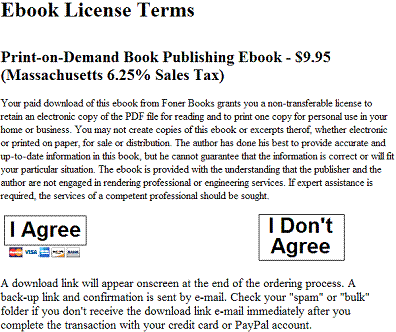
I started selling eBooks again in 2008, using PayPal to process the money and e-Junkie.com to handle the downloads. Initially, I had some problems with customers paying for an eBook and not receiving the download link because it bounced off their e-mail filter. Eventually I figured out it was my fault for trying to customize the e-Junkie "Thank You" message, and once I fixed that, the success rate for eBook sales transactions jumped up to around 99%. Of the 1% who have problems, half may be real download issues with fire walls or connections and the other half are probably scammers, but it's not a big deal in any case.
As an English language eBook publisher, just under 70% of my eBook sales come from the United States, where eBooks don't appear to cannibalize from paper book sales in any significant way. My international eBook business has already reached 65 countries, with the UK, Australia and Canada being the biggest customers. Other countries where I've sold five or more eBooks include: Spain, South Africa, Saudi Arabia, New Zealand, Netherlands, Malaysia, Mexico, Italy, Ireland, India, Germany, France, Denmark, Brazil and Belgium. Altogether, my international sales come to 487 copies as of this morning, for a net profit around $6,000. Most of those customers would never have paid for and waited for a printed book if the eBook option wasn't available. I have speculated, however, that the availability of print books may help sell eBooks by demonstrating that they are true books and not some cut-and-paste public domain snippets from the web.
The ten links embedded above in this post explain how to sell eBooks, but they don't specifically address how to market eBooks because there's no difference between marketing ebooks and marketing printed books online. I leave choice of whether to buy an eBook or a paper book to the customer. The only marketing I do for my eBooks are the text links on this website; no pop-ups, no paid advertising, no sending e-mails to previous customers or people who have contacted me with questions. I haven't set up any affiliate programs or placed my eBooks in any online bookstores, yet I average around $1500/month in eBook sales with just three eBooks. More aggressive marketing would probably raise sales, but it's not part of my basic business model. Authors and publishers who want their website to be popular enough to sell eBooks could do worse than reading through my redacted guide to online book marketing. And let me know if you have any complaints since I'm getting around to the first edit, two years after posting it:-)
You will need to a reseller tax ID to sell anything in states with sales tax in the United States. I collect Massachusetts 6.25% sales tax on eBooks sold in-state and pass the money on to the Department of Revenue each year. Assuming you are selling your own eBooks, you'll want to file a copyright for each one you publish, unless they are simply electronic versions of your printed books. Sticking a copyright notification in the text does not give you the same protection as paying to register a copyright. There are two distinct approaches to selling eBooks. The first is publishing quality eBooks the same way you would paper books, which is my eBook business model. The other approach involves buying resale rights from a so-called master reseller. That's basically a get-rich-quick scheme based on heavy use of advertising, and I seriously doubt anybody has ever gotten rich doing it, unless it's master resellers who grind out eBooks and resell them to "downstreamers."
Once you've written your eBook and put it through the editorial and proofreading stages, you have to decide what form to sell it in. I can't get excited about ePub or other special eBook formats. Until there are a billion dedicated ebook readers out there, why limit your sales by focusing on proprietary readers? I currently sell printable PDF eBooks generated directly from Microsoft Word, without any active DRM (Digital Rights Management). Although the eBooks I've published this way have appeared on file sharing networks, I haven't noticed any drop in sales, which pretty much move in lock-step with the number of serious visitors to my web pages. I should also note that the eBooks I published with DRM years ago have long been available on the same file sharing networks. After consulting with my publishing attorney, I decided to use a click-license to specify the terms of the eBook purchase. I'll paste in the license agreement for my POD ebook here:
I started selling eBooks again in 2008, using PayPal to process the money and e-Junkie.com to handle the downloads. Initially, I had some problems with customers paying for an eBook and not receiving the download link because it bounced off their e-mail filter. Eventually I figured out it was my fault for trying to customize the e-Junkie "Thank You" message, and once I fixed that, the success rate for eBook sales transactions jumped up to around 99%. Of the 1% who have problems, half may be real download issues with fire walls or connections and the other half are probably scammers, but it's not a big deal in any case.
As an English language eBook publisher, just under 70% of my eBook sales come from the United States, where eBooks don't appear to cannibalize from paper book sales in any significant way. My international eBook business has already reached 65 countries, with the UK, Australia and Canada being the biggest customers. Other countries where I've sold five or more eBooks include: Spain, South Africa, Saudi Arabia, New Zealand, Netherlands, Malaysia, Mexico, Italy, Ireland, India, Germany, France, Denmark, Brazil and Belgium. Altogether, my international sales come to 487 copies as of this morning, for a net profit around $6,000. Most of those customers would never have paid for and waited for a printed book if the eBook option wasn't available. I have speculated, however, that the availability of print books may help sell eBooks by demonstrating that they are true books and not some cut-and-paste public domain snippets from the web.
The ten links embedded above in this post explain how to sell eBooks, but they don't specifically address how to market eBooks because there's no difference between marketing ebooks and marketing printed books online. I leave choice of whether to buy an eBook or a paper book to the customer. The only marketing I do for my eBooks are the text links on this website; no pop-ups, no paid advertising, no sending e-mails to previous customers or people who have contacted me with questions. I haven't set up any affiliate programs or placed my eBooks in any online bookstores, yet I average around $1500/month in eBook sales with just three eBooks. More aggressive marketing would probably raise sales, but it's not part of my basic business model. Authors and publishers who want their website to be popular enough to sell eBooks could do worse than reading through my redacted guide to online book marketing. And let me know if you have any complaints since I'm getting around to the first edit, two years after posting it:-)
Are Google Books On Demand Books Ready?
Despite the fact I've been advocating for Google Books to partner with a POD (Print on Demand) provider for years, there's something amiss that I can't quite put my finger on.

How about two fingers?

Or the whole hand:-)

I only downloaded one book from Google Books this year, and it included more than a half dozen such image errors which I'm going to call "finger spam." Google has come to dominate the competitive business of Internet search in large part because of their ability to fight spam. If they are going to be successful making scanned books available on demand, they're going to need to start fighting finger spam as well. My suggestion is that the Google Books department appoints Matt Cutts their new editor-in-chief.
There's a large difference between the search business and the book business that Google and On Demand Books may have missed in their deal to move scanned books back to print with the Espresso Book Machine. The book business, even the out-of-copyright public domain book business, employs people called editors, who at least glance at the pages before putting a book in print. The search business is about incremental improvements, where "good enough" is as good as it gets. The book business is fussy, and readers who encounters finger spam in the wrong location aren't going to click on the next result. They're going to ask for their money back and buy their next book from Amazon or visit a library instead.
I've been writing about Google Books since 2005 and came out in September of that year with a quote Google uses on their website, that Google Books (then called Google Print) can only help book sales. Since that time I've frequently commented that making the scanned eBooks available on-demand through a partnership with Lightning Source or another POD vendor was the logical next step. Well, the logical next step was actually selling eBooks, a program I signed up for in early 2006 that Google never got around to implementing. And as recently as June of this year I recommended that Google hook up with On Demand Books and their Espresso 2.0 Book Machine in this hurried video (around 2:30 in if you want to skip forward:-)
I'm not having a change of heart about the synergy between scanned books and POD or the benefit to the public of making out of print books available in print again, my problem is strictly with the implementation. Both Google and On Demand Books need to recognize that printing books with unreadable pages is a major no-no in publishing. I'm sure they realize that already, but in the world that Google has lived and worked up to this day, getting things right the first time has never been that critical. Perhaps Google plans to come up with an algorithm that tracks book returns and uses the data to determine which scanned books have problems that make them unreadable - an elegant engineering solution. But it's not good enough for readers who pay for a printed book, take it on vacation, and get to the final page of the novel where the hero - who knows?
Memo to public domain book publishers who didn't believe me when I told them that eventually Google or Amazon would eat their lunch: On Demand Books is just the first step, so heads up.
Memo to Google Books. Say "no" to finger spam. Don't do evil. Call Matt Cutts.
Memo to readers. I'm off for Rosh HaShanna this weekend, and I'm planning to revert to my old Tuesday posting schedule next week.
How about two fingers?
Or the whole hand:-)
I only downloaded one book from Google Books this year, and it included more than a half dozen such image errors which I'm going to call "finger spam." Google has come to dominate the competitive business of Internet search in large part because of their ability to fight spam. If they are going to be successful making scanned books available on demand, they're going to need to start fighting finger spam as well. My suggestion is that the Google Books department appoints Matt Cutts their new editor-in-chief.
There's a large difference between the search business and the book business that Google and On Demand Books may have missed in their deal to move scanned books back to print with the Espresso Book Machine. The book business, even the out-of-copyright public domain book business, employs people called editors, who at least glance at the pages before putting a book in print. The search business is about incremental improvements, where "good enough" is as good as it gets. The book business is fussy, and readers who encounters finger spam in the wrong location aren't going to click on the next result. They're going to ask for their money back and buy their next book from Amazon or visit a library instead.
I've been writing about Google Books since 2005 and came out in September of that year with a quote Google uses on their website, that Google Books (then called Google Print) can only help book sales. Since that time I've frequently commented that making the scanned eBooks available on-demand through a partnership with Lightning Source or another POD vendor was the logical next step. Well, the logical next step was actually selling eBooks, a program I signed up for in early 2006 that Google never got around to implementing. And as recently as June of this year I recommended that Google hook up with On Demand Books and their Espresso 2.0 Book Machine in this hurried video (around 2:30 in if you want to skip forward:-)
I'm not having a change of heart about the synergy between scanned books and POD or the benefit to the public of making out of print books available in print again, my problem is strictly with the implementation. Both Google and On Demand Books need to recognize that printing books with unreadable pages is a major no-no in publishing. I'm sure they realize that already, but in the world that Google has lived and worked up to this day, getting things right the first time has never been that critical. Perhaps Google plans to come up with an algorithm that tracks book returns and uses the data to determine which scanned books have problems that make them unreadable - an elegant engineering solution. But it's not good enough for readers who pay for a printed book, take it on vacation, and get to the final page of the novel where the hero - who knows?
Memo to public domain book publishers who didn't believe me when I told them that eventually Google or Amazon would eat their lunch: On Demand Books is just the first step, so heads up.
Memo to Google Books. Say "no" to finger spam. Don't do evil. Call Matt Cutts.
Memo to readers. I'm off for Rosh HaShanna this weekend, and I'm planning to revert to my old Tuesday posting schedule next week.