Based on the quarter Amazon just reported, bringing North American media sales to $5.350 billion for the 2008 calendar year, and given Barnes&Noble's guidance of a sales decrease for the last quarter of 2008, I think my prediction that Amazon would become the largest book retailer in the US in 2008 is looking pretty good. They certainly sold more media in North America during 2008 than Barnes&Noble, the only question is whether Amazon is selling a much larger proportion of DVD's and other non-book media than Barnes&Noble. It would need to be a much larger proportion since I'm estimating Amazon's North American media sales will come in about 18% higher than Barnes&Noble's overall media sales in 2008. Keep in mind that Amazon also sells more new titles at a discount, and a large number of new and used and third party books for which they only receive transaction fees, which makes the number of units sold much higher than the dollar revenue suggests. I'd be surprised if Amazon's total number of physical books sold isn't already appreciably higher than Barnes&Noble's. It's also worth noting that Amazon's international media sales exceeded their North American media sales for the first time in 2008, and did so by nearly $400 million.
I've written in the past that small publishers shouldn't try to run their businesses like large publishers because the big trade model just can't be scaled down to a hundred or a dozen titles, much less one or two. The same is true for independent bookstores vs bookstore chains. But in recent months, the hunters are rapidly becoming the hunted, with Borders chain fighting for survival and large publishers cutting staff and frontlist plans. Let's take the problem facing the Barnes&Noble, Borders and Books-a-Million first. Large retail chains are built to function as large retail chains. They can't decide tomorrow to focus on the 20% or 30% of their stores with the best sales and close the rest, the lease agreements or mortgage payments for stores alone make that impossible without bankruptcy filing and protection. They have hundreds of millions of dollars locked up in inventory, and need lots of cash flow to pay creditors, employees, etc. The big bookstore chains will live or die as big bookstore chains.
Large trade publishers face a more complicated future because they appear to have more options than the retailers, but some of those options are illusions. Many publishers are currently seeking salvation in ebooks, approaching the business like Internet start-ups in the Dot Com era - eyeballs first, worry about profit later. Everybody likes talking about the number of titles they have available for Kindle, but I haven't seen much bragging about the bottom line. I seriously doubt that any of the large publishers talking about deriving half of their sales from ebooks in the near future could remain in business if that boast became a reality. A small nonfiction publisher can sell ebooks through content based website and add 20% or more to the bottom line of a the business, but the large publishers are depending on retailers (primarily Amazon) to sell their (primarily) fiction ebooks. Publishers currently treat ebook sales of backlist books as pure profit, since the acquisition and development costs were amortized years ago on the offset runs, but good luck financing their business models going forward if they have to depend on ebook profits to pay all their costs.
Publishers continue to obsess about book returns as the problem without realizing that any form of non-returnable books are the displacement technology that renders their core business model obsolete. The expertise at large publishers is in managing the large offset run returnable book model, without those they're on the same playing field with Tom, Dick and Harriet. Expect to see terminal consolidation of the large trade publishers, with the value of the publishers being measured by their backlists rather than superstar authors or name editors. When the 90% of popular backlist titles protected by copyright are held by two or three companies, we'll see whether the remaining retailers or the publishers hold the most power. The smaller publishers without expensive Manhattan offices and warehouse space leased for fifteen years are probably the safer bet for the next few years if you're new to the business and looking for a job. But somewhere down the road, when there are only two big retailers and two big publishers left standing, the economies of scale may tilt again against the small guys.


Information Tilt Causes Game Over
How many times have you seen an old-hand on a publishing list telling a newcomer that it's impossible to publish a book using Word or that shelling out a few thousand for a unique cover design is a must? How many times have you read on a website that registering a copyright isn't important or that book reviews and traditional media publicity should be the prime concern of a publisher? How many times have you seen a blog stating that Amazon requires a 55% discount from self publishers and Barnes&Noble will never stock self published books? Is the moon really made from library discards? Somebody could create a television series based on publishing industry myths, apocryphal stories, and outright falsehoods.
The problem isn't with the Internet media, it's with the authors of this "information", and it applies to many books on the publishing subject published by major trades. Unfortunately, newcomers to publishing are so overloaded with information that it would be a miracle if they could sort wheat from the self serving and often bitter chaff. What I've come to call information tilt often results in breaking the bank of new publishers either through direct expenses or by leading them in unproductive directions that result in long delays and despair. The saddest part for me is when I fail to convince new publishers that something they've been told is factually wrong because they've heard it from too many people who've done an effective job of playing on their fears. Hopefully, this graph will clear things up:
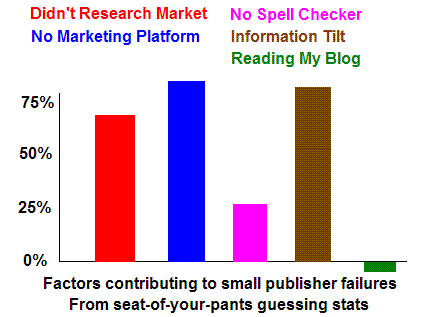
I chose the term "tilt" from my long-ago pinball days because I think it's very applicable to a process where new publishers frantically turn in every direction, just like a steel ball banging around on flashing bumpers, until a convulsive effort in one direction or another results in: Tilt - Game Over. If you're an author who has already written a book and just wants to see it in print, by all means, sign up with a service for a few hundred dollars and get it off your plate. But if you're approaching publishing as a business, slow down, step back from the table and get your ducks in line. Remember, there are plenty of good reasons to write a book for which there's no market, but there are few good reasons for a business to publish one.
I came across a real gem the other day for content publishers who want to start building a marketing platform with the help of screen capture video. It's called CamStudio, and it's a great piece of software after you tweak it a little. A few minutes after I downloaded it, I began a quick tutorial for another piece of free software, free in the sense that it comes with every copy of Windows, the much maligned Paint (from the Accessories menu). I often use Paint to knock out quick graphs for this blog, starting with making the graph paper. The third of the screen capture videos I made is the most colorful, so I'll paste it in here:
I'm not using an external microphone, I'm just talking into the air and the built-in microphone of my laptop is picking up my voice. The rest requires nothing besides a little imagination and the ability to babble on. If anybody sits through the whole video you get the prize of your choosing, providing you can find somebody to buy it for you:-)
The problem isn't with the Internet media, it's with the authors of this "information", and it applies to many books on the publishing subject published by major trades. Unfortunately, newcomers to publishing are so overloaded with information that it would be a miracle if they could sort wheat from the self serving and often bitter chaff. What I've come to call information tilt often results in breaking the bank of new publishers either through direct expenses or by leading them in unproductive directions that result in long delays and despair. The saddest part for me is when I fail to convince new publishers that something they've been told is factually wrong because they've heard it from too many people who've done an effective job of playing on their fears. Hopefully, this graph will clear things up:
I chose the term "tilt" from my long-ago pinball days because I think it's very applicable to a process where new publishers frantically turn in every direction, just like a steel ball banging around on flashing bumpers, until a convulsive effort in one direction or another results in: Tilt - Game Over. If you're an author who has already written a book and just wants to see it in print, by all means, sign up with a service for a few hundred dollars and get it off your plate. But if you're approaching publishing as a business, slow down, step back from the table and get your ducks in line. Remember, there are plenty of good reasons to write a book for which there's no market, but there are few good reasons for a business to publish one.
I came across a real gem the other day for content publishers who want to start building a marketing platform with the help of screen capture video. It's called CamStudio, and it's a great piece of software after you tweak it a little. A few minutes after I downloaded it, I began a quick tutorial for another piece of free software, free in the sense that it comes with every copy of Windows, the much maligned Paint (from the Accessories menu). I often use Paint to knock out quick graphs for this blog, starting with making the graph paper. The third of the screen capture videos I made is the most colorful, so I'll paste it in here:
I'm not using an external microphone, I'm just talking into the air and the built-in microphone of my laptop is picking up my voice. The rest requires nothing besides a little imagination and the ability to babble on. If anybody sits through the whole video you get the prize of your choosing, providing you can find somebody to buy it for you:-)
Publishing Technology vs Content (Yes, it is versus)
Today I dropped the "self" from the title of this blog because I find I'm writing more and more about general publishing issues, of which self publishing is a subset. But don't expect me to become a publishing technologist. I see the technology and content components of publishing as existing in opposition to each, rather than in partnership. To quote a well known former self publishing blogger of the 21st century, "Technology is the last refuge of a scoundrel." I'm not such a Luddite to question the value of cut-and-paste in editing, though as the video below shows, I find cutting the more valuable of the pair:
The publishing world is rapidly filling up with new standards and devices, none of which I believe are doing anything to boost readership, or literacy. The large trades and newspapers are rapidly cutting back on employees, and it's not simply a question of their audiences migrating to reading elsewhere. In many cases, their audiences are simply giving up reading in the long form, and satisfying themselves with blurbs of news and "culture" delivered through e-mail portals that they can click and follow to a news website or YouTube if desired.
The core misconception about publishing technology is that it provides a solution, when in reality publishing technology is a tool, and often a problematic tool at that. Publishers who think that a new technology is going to change the popularity of their books or their web content with their audience are fools. At best, chasing the latest standards and devices may give the earliest adopters some PR opportunities, as most publishing journalists are obsessed with technology because it provides the easiest fodder for a regular column. But the time and money those publishers invest in adopting the new technology only makes sense if it provides a profitable revenue stream.
Books may slowly give way to some form of ebooks, but it's not publishers who will shape or control this transition, it's the reading public. As a lifetime addicted reader, I don't have any doubts about the crowning glory of the printed book. It's the ability of a novel to lift the reader out of the surrounding environment, be it an armchair or a subway car, and into the world created by the author and the reader's joint imaginations. While some ebook devices may succeed in doing this, I don't believe that a dedicated ebook reader, such as the Kindle, has a long term future as a single function device. And as soon as you are receiving e-mail alerts or phone calls on your ebook reader, the basic function of the novel in creating an alternative universe is shattered.
Clearly, I don't control the future of Kindle and Sony reader, or the multi-function devices already used to deliver book content, like cellphones, MP3 players, laptops and desktop computers. But neither do the manufacturers or the publishers control the future of these devices, it's all up to consumer choice. My suspicion is that even devices like dedicated ebook readers for public school students which would seem no-brainers will be overtaken by the potential of technology to "add" to the book experience. Therefore, I believe that non-printed books will always suffer from dilution by addition, even though the market share of paper books may one day occupy the market share position that ebooks hold today.
The publishers who survive will be those who concentrate on producing the best possible content for their audiences. Those publishers who fail to identify their audience are wasting their time even thinking about delivery platforms. Once you identify your audience, if it turns out they are all Oprah watchers, by all means release a Kindle edition. But don't put your trust in technologies that promise profits down the road if and when the business model firms up. That only works for the Googles and the Amazons of the world. Any business can buy incremental unit sales at a negative profit margin, but it's simpler to stand on the corner handing out $20 bills until you go broke.